
Stages, experiences and influences in the work of Salvador Dalí
Dalí Pintores Catalanes Contemporaneos Pintura contemporánea Surrealismo Arte contemporáneo Pintura Vanguardias“I believe in magic which, ultimately, is merely the power to materialize imagination into reality. Our super-mechanized age underestimates the properties of irrational imagination, which is nonetheless the basis of all discoveries.”
Salvador Dalí
“I am surrealism,” Salvador Dalí affirmed. And his words live on and resonate in history despite the passage of time. His prolific and unique creation marked a turning point in the art world, giving rise to the figure, the legend, the myth; invoking the memory of an artist who knew how to win the battle against memory with his gaze, his technique, and his temperament.
To speak of Dalí is to speak of living genius, of pure avant-garde, of the rawest surrealism. Dalí is art, and art never dies.
Salvador Dalí: a precocious genius
Born in Figueres (Girona), in 1904, Salvador Dalí was not, during his early years, a brilliant student, although he did show a precocious interest in art.
His first contact with the world of painting took place in his earliest childhood when, as a result of reading the Gowan’s Art Books Collection, he began to feel a fascination for the sensuality exuded by Rubens' nudes and for the symbolism enclosed in the works of the Flemish masters.
However, these first affairs with painting did not only come through printed paper; the future artist was also imbued with Impressionist aesthetics before reaching adulthood, thanks to his stay at the El Molí de la Torre estate, owned by the Pichot family on the outskirts of Figueres, where he had the opportunity to enjoy the art collection owned by Ramón Pichot, who, moreover, became his first reference as a professional artist, whom the young Dalí would take as an example.
It was during his high school years that Dalí began to focus on the art world, starting to stand out in the academic environment thanks to the motivation his teachers were able to provide. Thus, during his time at the Figueres high school, the young genius collaborated with the student magazine Studium, publishing a series of art chronicles in which he wrote about Goya, Dürer, El Greco, or Velázquez (+link to https://subastareal.es/blog/la-pintura-religiosa-en-velazquez), some of his most admired artists; and painting classicist works such as Marina (Seascape) (1916) or Cadaqués; Playa de Es Llaner (Cadaqués; Es Llaner Beach) (1916), where it is possible to appreciate the Impressionist influences he received during this first formative stage.
This admiration for the great masters of painting materialized in an immense body of his own work that began to see the light from 1919, the date on which Dalí held his first group exhibition, sharing a wall with other painters from Figueres in the town's old Municipal Theatre, today the Dalí Theatre-Museum. In this exhibition, Dalí received, for the first time, critical acclaim, when Josep Puig Pujades wrote the following words about his early works:
“The man who feels light like Dalí Domènech, […] is already an artist of the kind who will be talked about. […] We salute the new artist and have firm hope that with the passage of time our words […] will have the value of a prophecy: Salvador Dalí Domènech will be a great painter.”
Josep Puig Pujades in Empordà Federal, January 11, 1919
Salvador Dalí's Madrid period
When he reached the age of 18, the year he entered the Royal Academy of Fine Arts of San Fernando, Salvador Dalí already had dozens of works behind him: he had cultivated landscape, portraiture, drawing, still lifes, and genre scenes, and his works had already been exhibited in various shows and received some awards, so, despite his young age, he was no longer a beginner, a reality of which he himself was aware, as attested by the thoughts preserved for posterity in his youth diary, from which we allow ourselves to pull a fragment that denotes the security and confidence the young artist placed in his talent:
“I will go to Madrid, to the Academy of Fine Arts. There I plan to spend three years working like a madman. […] Sacrificing myself and clinging to the truth is never too much. Afterwards, I will win the scholarship to go to Rome for four years; and upon returning from Rome, I will be a genius, and the world will admire me. Perhaps I will be despised and misunderstood, but I will be a genius, a great genius, because I am sure of it.”
Salvador Dalí, April 1921.
His move to Madrid to pursue his studies at the San Fernando Academy is one of the decisive moments in Salvador Dalí's life and work. During this stage, he began his relationship with some of the greatest intellectuals of 20th-century Spain, among whom Federico García Lorca and Luis Buñuel stand out, with whom he would form the most emblematic artistic group of this time, forging a fruitful friendship that would be maintained over the years, transcending the personal sphere and making history in the art world.
Although the young Dalí approached his learning with enthusiasm and perseverance, his time at the San Fernando Academy was not without controversy, as he was temporarily expelled for leading a student protest. However, Dalí took advantage of this sabbatical year to continue his instruction, initiating himself in the art of engraving under the guidance of Juan Núñez, his teacher during adolescence. It was also during this break in his studies that he had his first encounters with Cubism, through reading the futurist catalog “Pittura Scultura Futuriste (Dinamismo Plástico)” (Futurist Painting Sculpture (Plastic Dynamism)) and the magazines L’Esprit Nouveau or Valori Plastici .
Upon his return to the San Fernando Academy, his work had already materialized, adopting the values acquired from his self-taught approach to Cubism, as we can see in works like Naturaleza Muerta; Sandía (Still Life; Watermelon) (1924), with a marked avant-garde character; Retrato de Luis Buñuel (Portrait of Luis Buñuel) (1924) or Bañista, Retrato de Joan Xirau (Bather, Portrait of Joan Xirau) (1924), where, despite the classicist aesthetics, a marked structuring of volumes, typical of Cubism, can be appreciated. These works first came to light in 1925 at the First Exhibition of the Society of Iberian Artists, considered a fundamental milestone in contemporary Spanish art.
Also during these prolific years, the artist held his first solo exhibition, in 1925 at Galerías Dalmau in Barcelona, where he exhibited, on the one hand, works of a marked classicism, such as Muchacha Sentada (Seated Girl) (1925) or the emblematic painting Figura en una Finestra (Figure at a Window) (1925), in which we can see clear links with the Catalan pictorial tradition; and, on the other, paintings imbued with the restlessness of Cubism and abstraction, such as Naturaleza Muerta; Sifón y Botellita de Ron (Still Life; Siphon and Little Bottle of Rum) (1924).
Towards a personal pictorial language: Dalí's descent into the surrealist abyss
Classicism and avant-garde meet during these years in Dalí's work, beginning to define a symbiotic pictorial language that combines, with astonishing plasticity, the most disparate elements, making his paintings unique and recognizable. Thus, we already find in Venus y un Marinero (Venus and a Sailor), first exhibited in 1925, the traits that would eventually define the painter's highly personal artistic universe, the culmination of a long journey of learning and experimentation in search of his own pictorial style, which is, at the same time, personal (insofar as it is original) and collective (insofar as it is influenced by the idiosyncrasy of his time).
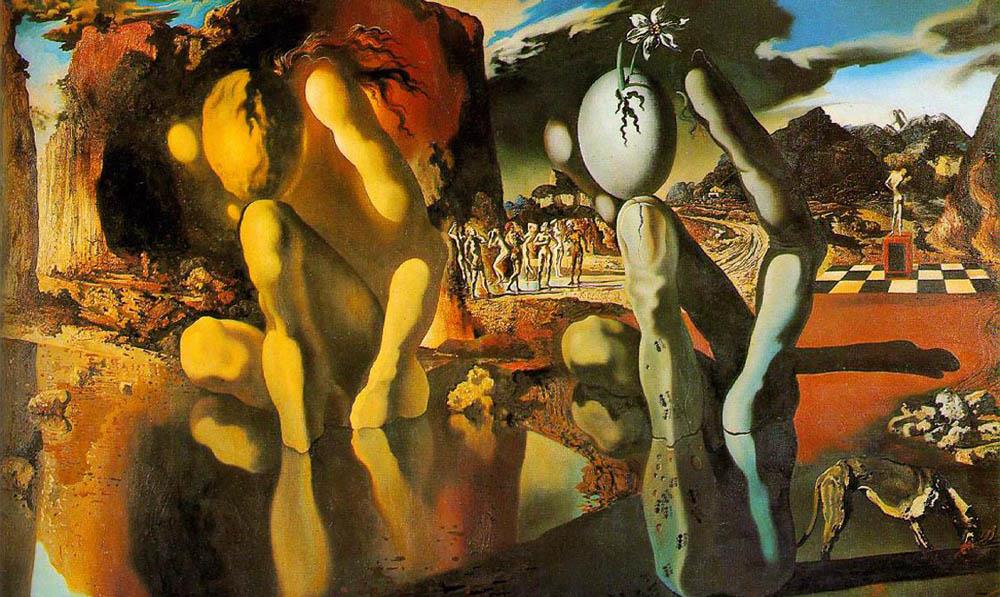
It is also during the last five years of the 1920s that surrealism begins to make an impression on Dalí's production, thus anticipating some of the elements that would end up defining the rest of his artistic career, such as amputated limbs, figures in a state of putrefaction, or fish; with which he begins to abandon his initial classicism to start outlining a more particular language, as we can appreciate in works like La miel es más dulce que la sangre (Honey is Sweeter than Blood) (1927) or Aparato y mano (Apparatus and Hand) (1927), which inaugurate the artist's personal fall into the abyss of surrealist figuration.
As this surrealist and unsettling aesthetic that Dalí's compositions begin to display starts to take shape, so does the controversy that would accompany all areas of his life, finding its first manifestation when his work Los deseos insatisfechos (Unsatisfied Desires) (1928) was withdrawn from the III Saló de Tardor (Autumn Salon) by the exhibition director, who considered it obscene, thus proving the surrealist right, who years before had prophesied the rejection to which his genius would confine him.
Thus, Dalí's gradual fall into the surrealist abyss begins in 1926 and is clearly documented in the correspondence the painter maintained with his friend Federico García Lorca, whom he kept informed of his philosophical and artistic tribulations, which eventually took shape, in 1927, in the famous article San Sebastian (Saint Sebastian), where he explains the bases of his new aesthetic.
A year later, the theoretical and iconographic foundation of his paintings definitively took shape in the Manifest Groc (Yellow Manifesto) (1928) or Catalan Anti-Artistic Manifesto, one of the most transcendent Spanish avant-garde manifestos, in which Salvador Dalí himself, along with the signatures of Sebastià Gasch and Luis Montanya, attack the hegemonic Catalan culture of the time and propose a new cultural order based on the elements of industrial society.
Dalí in Paris and his time leading the Surrealist Group
It is in 1929 when Salvador Dalí definitively makes a one-hundred-and-eighty-degree turn in his pictorial universe and his own life. During this year, Dalí arrives in Paris to premiere the film Un perro andaluz (An Andalusian Dog) (1929), a film by his friend Luis Buñuel, in which the painter collaborated as a screenwriter.
In the French capital and thanks to the mediation of Joan Miró, with whom he had maintained postal correspondence, he comes into contact with the surrealist group, of which he becomes one of its greatest exponents, making a profound impression on some of its most prominent members, especially André Breton.
Dalí's involvement in the surrealist group is extremely productive: the artist participates in symposiums, edits publications, signs manifestos, and exhibits his works in different countries. Examples of the fruitfulness of this era are some of the painter's most recognizable works, such as El Gran Masturbador (The Great Masturbator) (1929), La persistencia de la Memoria (The Persistence of Memory) (1931) or Cisnes Reflejando Elefantes (Swans Reflecting Elephants) (1937), in which his personal inventiveness fully takes shape in a pictorial universe as exuberant as it is unsettling.
However, despite the fruitfulness of this stage, Dalí's collaboration with the surrealists comes to an end after several political disagreements that end up straining the relationship between the surrealist painter and André Breton, who eventually requests Dalí's expulsion. Although the disagreements were diverse, one of the most notorious was the one that took place regarding the work El enigma de Guillermo Tell (The Enigma of William Tell) (1933), where the Russian ideologue Lenin is depicted with an abnormally elongated buttock, a fact that led to André Breton's discontent, concerned about Dalí's political ideology. His definitive expulsion would take place in 1939.
Beyond the experiences and influences received during his time leading the Surrealist Group, the 1930s also represent a turning point for Dalí for other reasons: it is also during this time that he meets Gala, whom he would marry in 1934, from which moment they would never be apart, she becoming his inspiring muse, as attested by some of his best-known works, such as L’Angelus de Gala (Gala's Angelus) (1935) or Mi mujer desnuda contemplando su propio cuerpo (My Wife Nude Contemplating Her Own Body) (1945).
The Dalí – Gala couple in the United States: the international consecration of the genius
After the disagreements with André Breton that culminated in his expulsion from the Surrealist Group, and due to the incursion of German troops into Bordeaux in 1940, the Dalí-Gala couple decided to move to the United States, where they would remain for eight years.
It was during this stage that Dalí achieved his total artistic consecration, coming into contact with great names in the cultural scene, such as Alfred Hitchcock, the Marx Brothers, or Charles Chaplin; and holding exhibitions in major American galleries and museums.
From his new intellectual circle, his abundant collaborations in films such as Hitchcock's Spellbound (1945), or in endearing animated short films like Destino (1946), by the Disney corporation, are noteworthy; as well as his participation in set design for musical shows such as A Surrealist Night in an Enchanted Forest (1941).
Also deserving special mention is Dalí's facet as a jewelry designer, which he developed during his American period with jewelers Alemany and Ertman, for whom he created fantastic jewelry sketches intended to reflect the conception and evolution of the artist's pictorial universe. Noteworthy are El corazón real (The Royal Heart) (1953), a sculpture jewel created in homage to the Queen of England, imbued with strong symbolism; or El cáliz de la vida (The Chalice of Life), a clear allusion to the Renaissance era.
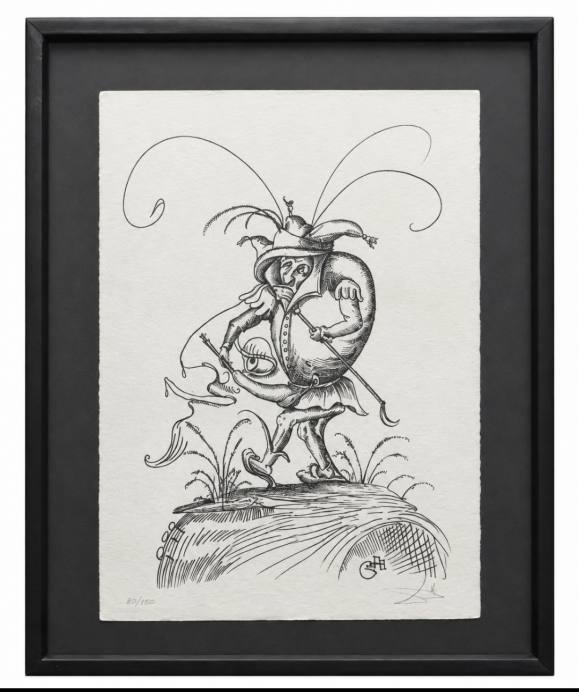
In a display of his multidisciplinary capacity, Dalí continued to cultivate, parallel to stage design and jewelry creation, his facet as a writer, publishing articles in magazines such as Vogue or American Weekly and drafting his own literary works, among which the novel Hidden Faces (1944) and 50 Secrets of Magic Craftsmanship (1948) are worth highlighting, a pictorial treatise in which he offers his own advice to new artists, and makes personal assessments of painters like Picasso, Velázquez, Raphael, or Ingres.
Regarding painting, Dalí anchored himself in this decade in a classicist vision with abundant nods to the Renaissance, as we can see in Slave Market with the Disappearing Bust of Voltaire (1940), Poesía d’Amèrica (Poetry of America) (1943) or The Basket of Bread (1945).
This American stage came to an end in mid-1948, when Gala and Dalí decided to return to Spain, where the painter would evolve into a new stage that, on the one hand, would bring him closer to the Spanish mystical tradition embodied by Saint John of the Cross or Zurbarán and, on the other, would lead him to create works related to the scientific advances of his time.
Salvador Dalí: “Why I was sacrilegious, why I am a mystic”
It was at the end of the 1940s when Dalí, back in Spain, turned a page to experience his mystical and nuclear stage, characterized by the treatment of religious themes from a scientific point of view, imbued with mathematics and the processes of nuclear fusion and fission, an obsession that materialized in the artist's universe following the launch of the atomic bomb at the end of World War II.
Dalí explained the foundations of this shift in his artistic production in the conference Why I was sacrilegious, why I am a mystic, held at the Ateneo Barcelonés in 1950, as well as in the document Mystical Manifesto, presented in Paris in 1951.
Witnesses to this very peculiar stage of Salvador Dalí's artistic career are works such as La Madona de Port Lligat (The Madonna of Port Lligat) (1950), Corpus Hipercúbicus (Corpus Hypercubus), Galatea de las Esferas (Galatea of the Spheres) (1952), El Cristo de San Juan de la Cruz (Christ of Saint John of the Cross) (1951) or Las Tentaciones de San Antonio (The Temptations of Saint Anthony) (1946); in which the artist shows his interpretation of religious themes through a mathematical interpretation of spaces and proportions.
Salvador Dalí's historical-allegorical stage
The 1960s were a time of revision for Dalí, during which he produced large works aimed at narrating historical events, reflecting his profound knowledge of academic art pompier. Noteworthy in this regard are works such as El Concilio Ecuménico (The Ecumenical Council) (1960) or La batalla de Tetuán (The Battle of Tetuan).
In parallel, Dalí also maintained his interest in scientific themes, focusing on genetics, a discipline he immortalized in impressive paintings such as Galacidalacidesoxiribunucleicacida (Galacidalacidesoxyribonucleicacid) (1963), in which the author captures his personal association between the structure of the genome and memories of his intrauterine stage.
In addition to these large-format works, Dalí began to focus his efforts on producing what he called total works of art, large-scale ready-made pieces in which to concentrate his entire artistic career, a will that would materialize in 1974 in the Dalí Theatre-Museum in Figueres, the largest surrealist object in the world and a place where it is possible to abandon reality to immerse oneself in the universe of the Dalinian subconscious.
Dalí and optical and technological experimentation
From the 1970s onwards, Salvador Dalí's career focused on experimentation, always seeking new scientific resources to support the artist's work. From this interest arose his approach to holography and stereoscopy, as ways of finding the door to a new dimension of vision with which to achieve a new stage of artistic splendor: a new Renaissance. We find an example of this philosophical and experimental claim in the work El Torero Alucinógeno (The Hallucinogenic Toreador) (1970), where the play of volumes and shadows dissolves into the background of the scene, a bullring.
Also during this decade, Dalí closely followed movements focused on optics and visual effects, such as pop art, optical art or Op-Art, and hyperrealism, giving rise to works like Odalisca Cibernética (Cybernetic Odalisque) (1978) or Gala desnuda mirando al mar que a unos dieciocho metros se transforma en el presidente Lincoln (Gala Nude Looking at the Sea Which at Eighteen Meters Transforms into President Lincoln) (1975), paintings in which he flirts with the pixelated image and its effects.
Salvador Dalí's Last Paintings
After Gala's death in 1982, Dalí immersed himself in a stage of introspection and melancholy in which he returned to the origins of his painting, creating paintings dominated by classical aesthetics and marked by a strong expressionist character, with frequent references to his deceased muse. Representative of this tragic stage are works such as Llegaremos más tarde, hacia las cinco (We'll Arrive Later, Around Five) (1983) or Contorsión topológica de una figura femenina convirtiéndose en violoncelo (Topological Contortion of a Female Figure Becoming a Cello) (1983), in which the referent and figuration lose strength before the expression and interpretation of his own sensations, now reminiscent, anchored to the past of his living genius.
Salvador Dalí's final works are, ultimately, a personal glimpse into his own death throes, into the twilight of his personal decline, a process he observes as an impassive spectator, contemplating the passage of time until it takes charge, in 1989, of definitively throwing him into the abyss of death, thus returning the genius to that inferno of organic and putrefied forms that, with his brush, he managed to make real in life; consecrating him in the metaphysical space of memory.
Eva VilarC.





Hola Buen día! Quería utilizar este artículo en mi tesis de grado, que fecha de publicación tiene?
Hola Luisa, el artículo se publicó el 11 de enero de 2016. Un saludo.
Hola, estoy preparando oposiciones a historia. Y este artículo me ha sido de mucha ayuda para preparar el tema de Dalí. Muchas gracias