
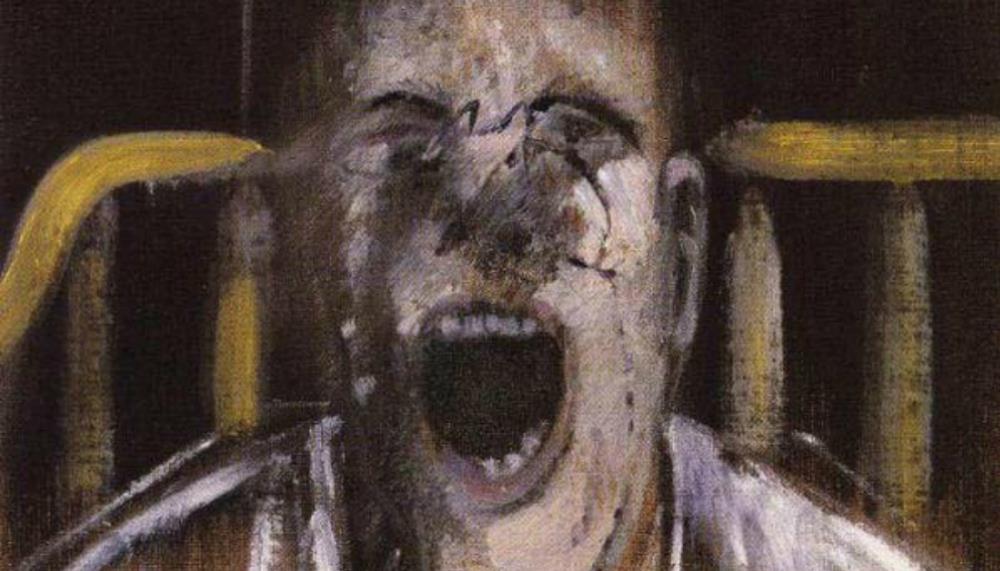
5 disturbing paintings that will make you shudder
Arte Pintura Arte insólitoOn these special dates when the line separating the world of the living and the dead seems to grow thinner, we present 5 dark paintings that show how the most terrible monsters and the most ancient fears that haunt the human mind also find their form of expression through art.
Do you dare to discover 5 works of art capable of making you tremble?
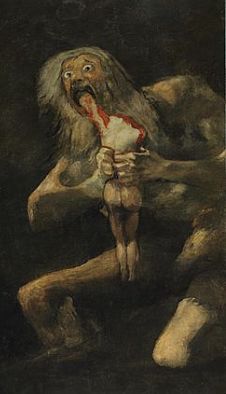 Saturn Devouring His Son, by Francisco de Goya
Francisco de Goya was an artist fascinated by the aesthetics of the grotesque, a fact that he highlights in many of his paintings, where he revels in death, mutilation, and deformity, as we can see in such sinister paintings as Saturn Devouring His Son (1820-1823), in which, with dark tones and gloomy atmospheres, Goya transports us to a realm of darkness buried in the primordial dawn of the world.
The painting, which belongs to the collection of the Prado National Museum, is inspired by the raw mythological scene in which the god of time devours his offspring to prevent them from dethroning him. Saturn's wild eyes, as well as the chiaroscuro of his decrepit body, or the bloody obscenity of the scene, make this work one of the most grotesque paintings in the history of art, possessing an expressiveness as extreme as it is unsettling.
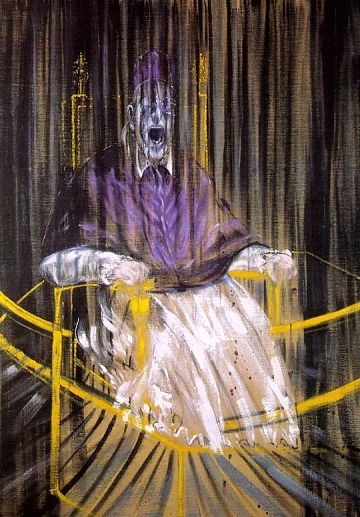 Study after Velázquez's Portrait of Pope Innocent X, by Francis Bacon
Another author who likes to confront the rawest and most grotesque aspects of human reality with his painting is Francis Bacon.
The Anglo-Irish artist creates a peculiar pictorial language with which to express the complexity of the time he lived in, giving rise to compositions as unsettling as Study after Velázquez's Portrait of Pope Innocent X (1953), a reinterpretation of Velázquez's Portrait of Innocent X (1650), where at first glance the now-deformed face of the Pope stands out, whose features appear malignant and threatening, as well as the dark atmosphere that surrounds him, contributing to creating a deeply expressive atmosphere.
Would you dare to hang it in your room?
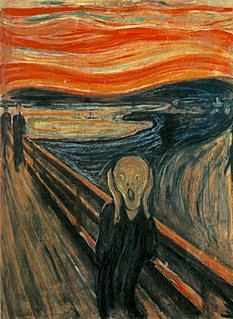 The Scream, by Edvard Munch
This is surely one of the first works you thought of when reading the title, and that is because there is no better representation of anguish than the famous painting The Scream (1893) by Edvard Munch.
This celebrated oil painting is one of the most acclaimed works in art history, not only for its obvious beauty but also for the profound unease it can cause in the viewer through the great expressiveness of the colors and the gesture of the main figure.
The seed of this painting lies in the painter's tormented life, who in 1892 wrote in his diary:
I was walking along a path with two friends – the sun was setting – suddenly the sky turned blood red – I paused, feeling exhausted, and leaned on the fence – there was blood and tongues of fire above the blue-black fjord and the city – my friends walked on, and I stood there trembling with anxiety – and I sensed an infinite scream passing through nature.
Munch captured this moment of the day in his painting Despair (1892), which he would later rework until arriving at the composition known throughout the world today as The Scream, a true icon of such universal feelings as fear or anguish.
Guernica, by Pablo Picasso
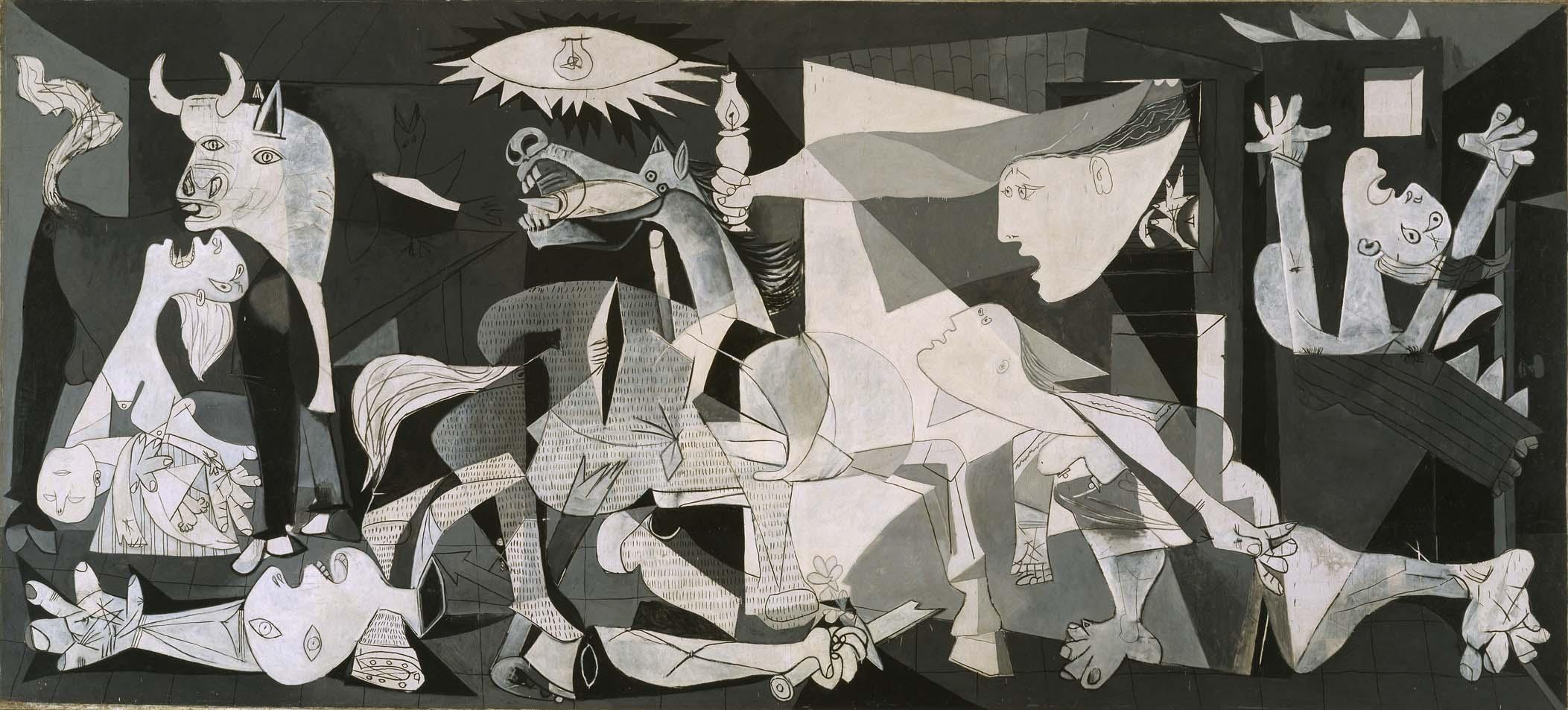
Guernica by Pablo Picasso is one of the most famous paintings in the world, which is why it might be easy to overlook all the horror and tragedy contained in this celebrated canvas. As is well known, Guernica is a denunciation of the German and Italian bombing that in 1937 took more than a hundred lives in the Basque town that gave the work its name.
If you visit the Reina Sofía Museum, where the work is exhibited, with just one glance at Guernica you can see the horror on each of the faces. The distorted faces, the amputated limbs. A particularly moving scene is that of the mother we find on the left of the composition, raising a heartbreaking cry to the sky while holding the lifeless body of a child. It is, without a doubt, a painting as beautiful as it is terrible.
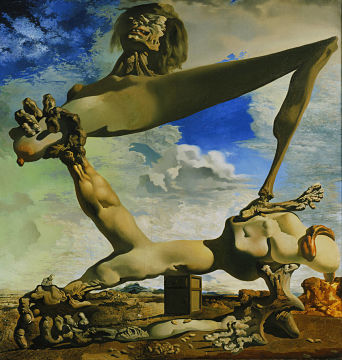
Soft Construction with Boiled Beans (Premonition of Civil War) (1936), by Salvador Dalí
Surrealism also made the decrepit and the grotesque its object of study, so the surrealist genius Salvador Dalí could not be absent from this list of unsettling paintings.
While all of Dalí's works display a profound symbolism in which we find numerous allusions to death or decay (like his iconic ants), one of the most terrible paintings we can find in Salvador Dalí's pictorial production is Soft Construction with Boiled Beans (Premonition of Civil War)(1936),
In this interesting work, we see a monstrous humanoid figure whose limbs are articulated without logic, thus managing to injure and trample itself. The head shows, in an indescribable grimace, the suffering experienced by the figure, subjected to such a state of internal disorder.
It is curious to observe the allegory of the effects of a civil war, which the painter predicted in advance, surely imbued with the convulsive social atmosphere of the time. The work was finished six months before the outbreak of the Spanish Civil War, although there is evidence that the painter was already working on it in 1934.
As you can see, art can evoke all kinds of feelings, from tranquility or joy, to unease, fear, or despair. And what feelings did these paintings produce in you?
We'll be delighted to read your comments!





Cuando abrimos los ojos, ya nos aplasta lo que podríamos llamar el peso de la existencia. Y la existencia humana es tan magnífica como terrible. Es esto último lo que hacen sentir estos cuadros.
Me parece fabuloso como el arte Grotesco estan hermoso y aparte nos cuenta la historia detras de cada cuadro.