
Jordi Puig (Barcelona, 1955): An Artistic Journey from Material Abstraction to Cubist Geometry
Subastas de arte online Pintura abstracta cubismoJordi Puig (Barcelona, 1955) is an artist who embodies the rich Catalan painting tradition, carrying with him the legacy of a family with deep roots in art: his grandfather, Luis Puig Barella, was a Neocentist painter, and his uncle, Agust Puig, was a prominent Informal painter and member of the influential Grup Dau al Set.
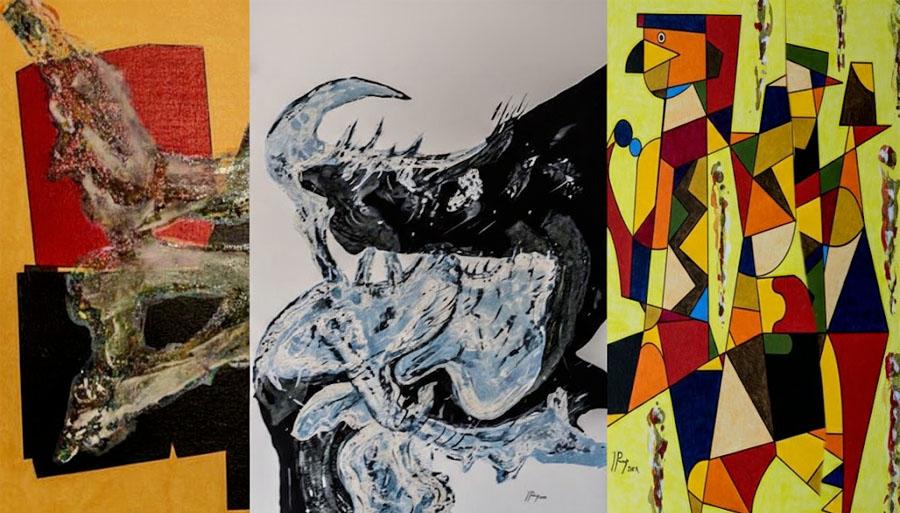
This family heritage is evident in Jordi Puig's remarkable versatility, as he has masterfully explored radically different pictorial languages throughout his career. An analysis of three of his works —Long Island (2013), Camino Real (2013), and Composición con cara (2017)— allows us to appreciate the breadth of his artistic vision.
I. The Matteric and Expressive Impulse (2013)
The works dated **2013**, **"Long Island"** and **"Camino Real"**, are clear examples of Jordi Puig's Informal and abstract painting, connecting directly with the Catalan matteric tradition. In these pieces, the artist prioritizes **texture**, **gestural quality**, and **emotional force** over figurative representation.
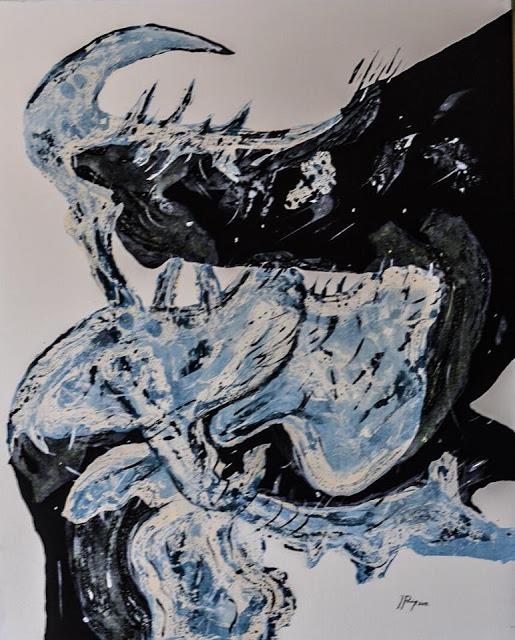
"Long Island" (2013)
-
Technique: Acrylic on cotton canvas (81 x 100 cm).
-
Analysis: This work is an explosion of drama. Using a reduced palette (black, white, and glacial blue), Puig creates an organic form, almost a mythological being or a powerful wave, erupting from the dark background. The brushstroke is fast and loaded, generating a **rough texture** that imbues the composition with intense energy and dynamic movement. The extreme contrast between the solid black and the white and light blue gives it a powerful and expressive presence.

"Camino Real" (2013)
-
Technique: Acrylic on canvas (81 x 65 cm).
-
Analysis: Here, the abstraction becomes more earthy and organic. The bright, warm ochre background is interrupted by angular black forms and a central structure reminiscent of **roots**, **intertwined branches**, or geological formations. The use of resins or pastes creates a glassy, translucent effect on these central forms, making them appear petrified or crystallized. The small inclusion of an intense red rectangle adds a point of visual tension and cold/warm contrast that vitalizes the composition.
II. The Geometric Metamorphosis (2017)
Four years after these matteric explorations, Jordi Puig performs a complete stylistic shift, demonstrating his ability to master structure and color in a totally different register.
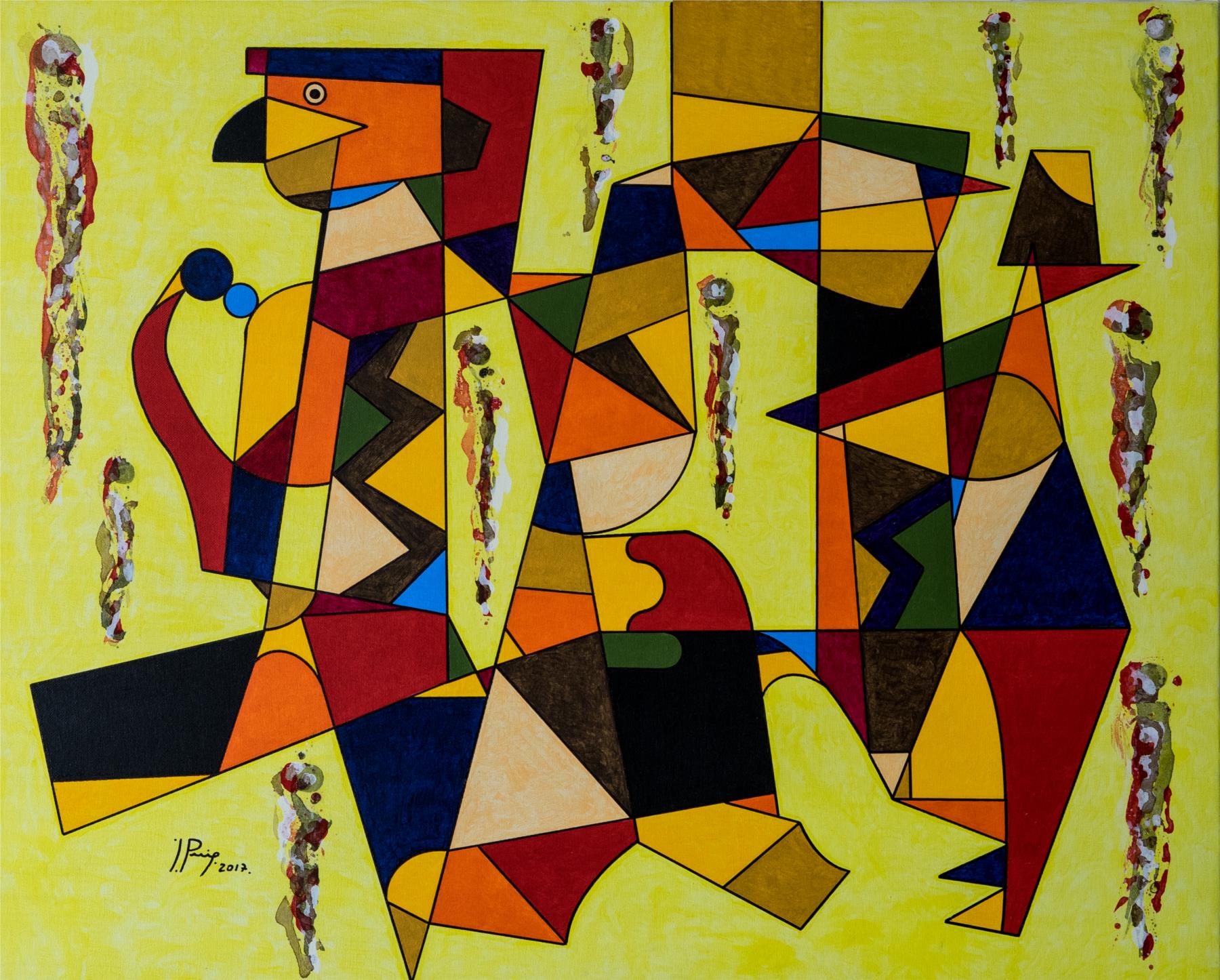
"Composición con cara" (2017)
-
Technique: Acrylic on canvas (81 x 65 cm).
-
Analysis: The 2017 work marks a transition towards an **analytic and synthetic Cubism** with a personal touch. The artist deconstructs figures (possibly characters with hats or masks, hence the title) into an intricate network of geometric shapes —triangles, rectangles, trapezoids— that interlock like a puzzle. The **black line** is now the protagonist, defining and separating the blocks of vibrant color (yellows, reds, blues, oranges, greens). Unlike the roughness of 2013, the surface here is flat, and the impact is purely visual, based on chromatic harmony and contrast against a lemon-yellow background. The vertical paint drips on the sides suggest an element of vitality or decomposition, adding a subtle layer of expressiveness to the geometric rigidity.
Conclusion
The collection of these three works reveals that Jordi Puig is not an artist confined to a single style. His trajectory is a constant dialogue between the **gestural freedom of Informalism** —with its emphasis on matter and pure expression— and the **formal discipline of Geometry**, where structured composition and color build a new figurative reality. This **stylistic duality** is not only a testament to his technical skill but also to his continuous desire to explore the infinite possibilities of the pictorial language.





Fantástico artículo sobre la obra de Jordi Puig, es un gran artista.